
Mercy – Budget of $200 million – 1 hour and 40 minutes
| Blu-rayTM | |||
|---|---|---|---|
 |
 |
 |
 |
| Digital | |||
 |
 |
 |
 |
Lawlessness broke out in Los Angeles after widespread job loss, homelessness, and addiction. The Mercy Court was introduced. It is judge, jury, and executioner. Since its inception, everyone has registered their devices with the Mercy cloud. Artificial Intelligence gathers all that data for Mercy Court. Anyone guilty of the most egregious crimes is sent there. Everyone is guilty until proven innocent. They have 90 minutes to use all the information at the AI’s disposal to prove their innocence. If they don’t, an apparatice sends a pulse to their brain to execute them. They are considered innocent if their guilt rating falls below a threshold of 92.5%. Detective Chris Raven and Jacqueline Diallo advocated for the new system, praising its results. Since its implementation, crime has reduced to 68%. The Mercy court has tried 18 cases, ending in executions.
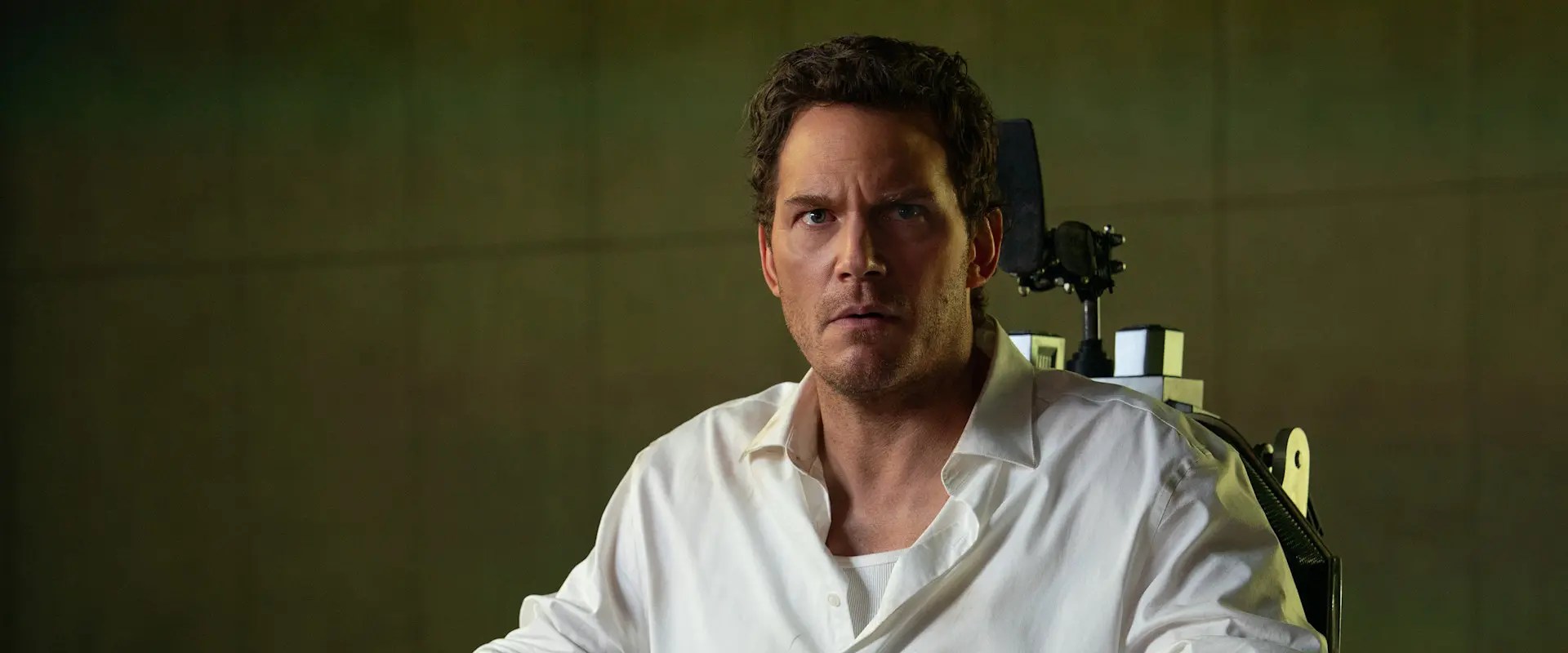
Chris wakes up from a drunken stupor to these facts as Mercy Courts’ commercial plays. He realizes he’s tied to a chair. Judge Maddox, an AI humanoid presence, greets him and requests that he exhale. The AI detects that the alcohol in Chris’s bloodstream has reduced to an acceptable level. He can stand trial for the murder of his wife, Nicole. Chris says he would never kill his wife. However, the AI believes he’s 97.5% guilty. It plays the security and ring cam video as evidence. He went to work but left early and drove to Nicole’s home. He rang the doorbell and demanded she let him inside. When she said no, he threatened to use his key. She refused again, so Chris punched the doorbell, disengaged it from the base, and grabbed his key to let himself in. Twenty-eight minutes later, Chris left the home. Later, their daughter, Britt, arrived home after a sleepover and discovered Nicole’s body. Nicole died from a knife wound that punctured a major artery. The police found Chris’s hair and fingerprints at the scene and drops of Nicole’s blood on his shirt. They tracked Chris to a bar. After a battle, the police apprehended him and brought him to Mercy Court. With the facts of the case in front of him, Judge Maddox asks Chris to enter his plea. Chris says he’s innocent. Maddox tells Chris that all her information is at his disposal. He has 90 minutes to prove someone else committed the crime or die. Will Chris survive?
You can not be late for this film. The twist ending won’t make sense without seeing the beginning. The plot capitalizes on people’s fears about AI in every aspect of society. While that’s the base of the movie, it’s a mystery with a ticking clock that drives the story. The clock keeps the film’s pace while increasing the tension. You feel the pressure as Chris sifts through calls, emails, and bank records. Also, he’s dealing with the human aspect. He has to prove to Britt and his colleagues that he’s not guilty to obtain their help. The plot gives you tidbits of the truth, and like Chris, you will overlook them the first time. That’s what makes this picture so intriguing. Even the AI starts to glitch and hallucinate as Chris unveils that the evidence can lie. The audience must remember that the film’s timeline is August 2029. So the technology is slightly futuristic. The hoverbike scenes’ graphics aren’t well done, but the exciting chase makes up for it. The story perfectly balances its action, mystery, and emotions. This film deserves a second watch. However, IMAX is enough. 3D isn’t necessary.
I give it 4.5 out of 5 stars
Well, that’s peachy – Chris
Everyone lies – Judge Maddox
| Blu-rayTM | |||
|---|---|---|---|
|
|
|
|
| Digital | |||
|
|
|
|




Share this:

Categories: chris pratt, In The Theater, Mercy, movie, Rebecca Ferguson, review


 thatdarngirlmovie.reviews